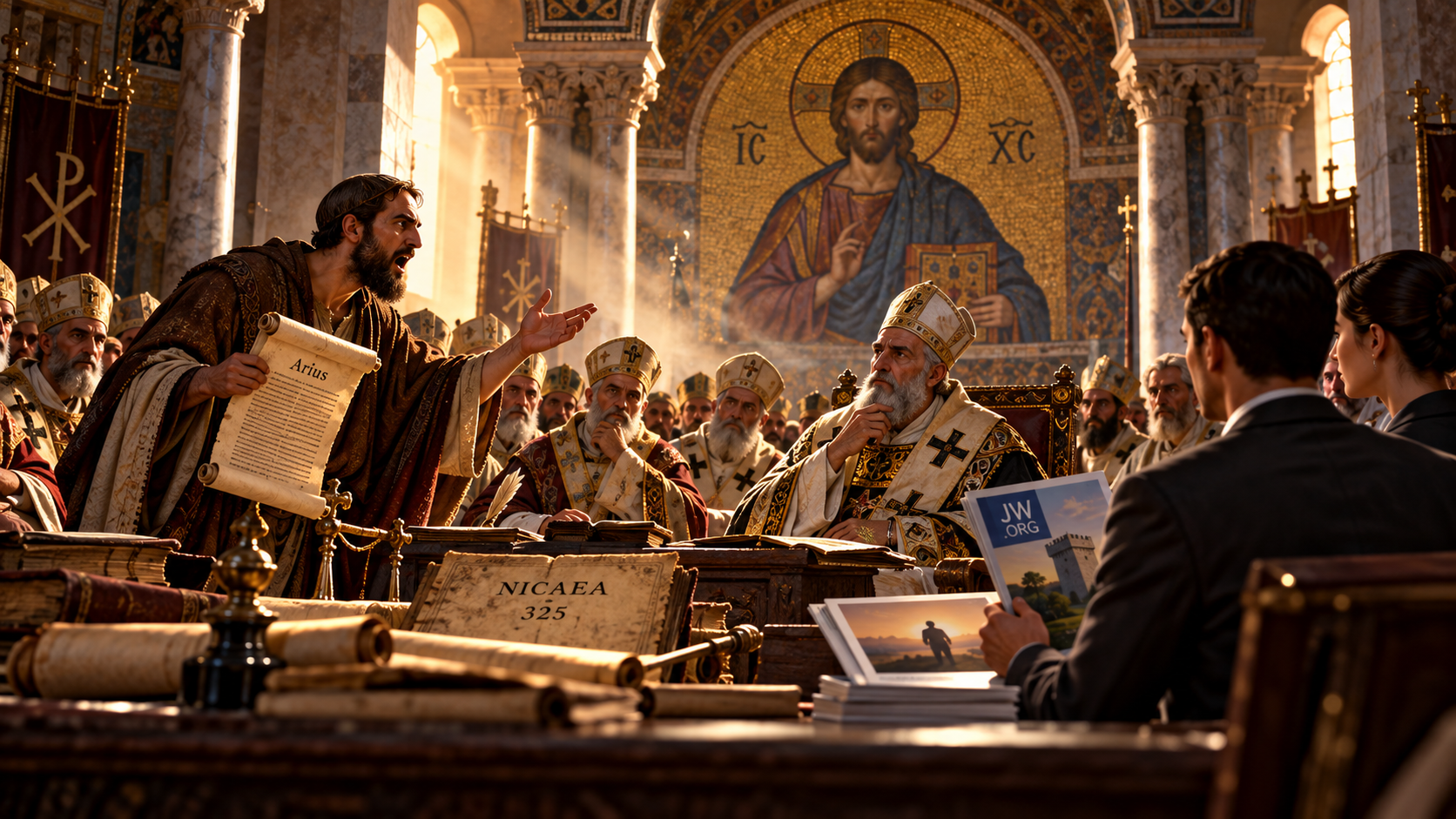
Christological Similarities and Differences in Ancient Sources, Official Publications, and the Nicene Creed
By Marconi Fábio Vieira
Abstract
This article compares the Christology attributed to Arius in the fourth century with the official teachings of Jehovah’s Witnesses, distinguishing doctrinal convergences, conceptual differences, and the limits of historical inference. Drawing on ancient sources, contemporary institutional publications, and a Nicene biblical-theological assessment, it argues that similarities concerning the Son’s origin, preexistence, and participation in creation do not establish complete doctrinal identity or direct historical continuity.
Keywords: Arianism; Jehovah’s Witnesses; Christology; Council of Nicaea; history of theology; Christian apologetics.
Why Compare Arius and Jehovah’s Witnesses?
The identity of Jesus Christ lies at the heart of one of Christianity’s most consequential controversies. In the fourth century, the debate associated with Arius, a presbyter of Alexandria, helped shape the Creed of Nicaea in 325. Many centuries later, Jehovah’s Witnesses came to defend an understanding of Jesus’ origin and status that bears certain similarities to propositions attributed to Arius. But how far does the comparison extend?
The question cannot be answered simply by labeling Jehovah’s Witnesses “Arian.” A responsible comparison must examine the surviving ancient documents, consult the modern movement’s official statements, and distinguish similarities from differences. Above all, it must not turn doctrinal analogy into evidence of historical continuity.
This article summarizes documentary and bibliographic research on the Son’s origin, his existence before his human birth, his relationship to God the Father, his role in creation, and his divine status. A confessional Nicene Christian assessment is presented separately rather than substituted for the description of the sources.
What Can the Testimonies Attributed to Arius Establish?
Arius was active in Alexandria during the early decades of the fourth century. His Christology must be reconstructed from letters and fragments transmitted under unequal conditions, often by authors who opposed his views. Relevant witnesses include his letter to Eusebius of Nicomedia, preserved by Theodoret, and the letter from Arius and his associates to Alexander, transmitted by Athanasius in De Synodis (§16).
These documents present the Father as without beginning, while the Son receives his origin from the Father, although he exists before the ages and participates in creation. They also assign the Son a distinctive status in relation to other creatures. The letter preserved by Theodoret even contains the Greek expression πλήρης θεός, which requires contextual interpretation and should not be erased from a serious historical reconstruction.
Another caution concerns immutability: letters associated with Arius make positive statements on this matter, whereas writings by his opponents contain polemical characterizations. Documents attributed to Arius, adversarial assessments, and propositions later condemned at Nicaea must not be indiscriminately conflated. Nor does “Arianism” designate an entirely uniform theological system (DELCOGLIANO, 2018).
What Did Nicaea Affirm in 325?
The Council of Nicaea responded to the controversy by confessing the Son as “begotten, not made” and “of one substance with the Father” (ὁμοούσιον τῷ Πατρί). The decisive issue was not merely whether Christ existed before his human life, but whether his origin belonged to the order of created beings or whether he shared the Father’s divine being.
The creed of 325 also included anathemas against certain propositions concerning the Son’s origin and susceptibility to change. This does not mean that every condemned proposition can automatically be attributed to Arius. The 325 text must also be distinguished from the Niceno-Constantinopolitan formulation associated with 381, without projecting later terminological distinctions back onto the original controversy.
What Do Jehovah’s Witnesses Officially Teach About Jesus?
In the official publications examined, Jehovah’s Witnesses present Jesus as the Son of God and Savior, existing in heaven before his human birth but directly created by Jehovah. According to lesson 15 of Enjoy Life Forever!, he is God’s first and only direct creation; all other things were then created through him.
The movement identifies Jehovah as the only Almighty God and rejects the doctrine of the Trinity. Its interpretation of Colossians 1:15 takes “firstborn of all creation” to mean that Jesus was the first created being. At Colossians 1:16–17, the New World Translation uses “all other things”; the study note acknowledges the Greek wording corresponding to “all things” and supplies an interpretive justification for its translation choice.
Another distinctive teaching identifies Jesus, in his heavenly existence, with Michael the archangel. The movement’s publications bring together passages such as 1 Thessalonians 4:16, Jude 9, and Revelation 12:7 to support this conclusion. It is a doctrinal inference drawn from reading those passages together, not an explicit statement of personal identity in any one of them considered separately.
Where Do the Convergences Lie—and Where Does the Analogy End?
The documentary comparison identifies four significant convergences: the Son receives his origin from the Father; he exists before his human life and before the creation of other things; he depends on the Father with respect to his origin; and he participates in creation. The Son’s derived origin and his dependence on the Father for that origin are related analytical dimensions, not independent lines of evidence. These similarities concern specific propositions, not the complete equivalence of theological systems separated by many centuries.
Differences also matter. The testimonies attributed to Arius use positive language concerning divinity and immutability that must be assessed on its own terms. The identification of Christ with Michael, by contrast, is documented in the official sources of Jehovah’s Witnesses but was not established in the selected ancient witnesses. On immutability, the modern sources delimited by the study did not permit a sufficiently precise comparison.
There is also a documentary asymmetry: the Christology attributed to Arius depends on fragmentary writings, some preserved by opponents, whereas the beliefs of Jehovah’s Witnesses can be described directly from current institutional publications. The silence of an ancient corpus cannot be assigned the same evidentiary weight as a contemporary official declaration.
Finally, the study did not identify a documentary chain establishing direct transmission from Arius to the modern movement. Similarity is not genealogy. The absence of proof of dependence does not establish that any influence was impossible; it means only that such influence was not demonstrated by the sources examined.
How Does Nicene Christianity Evaluate These Positions?
The confessional Nicene assessment draws on a set of biblical texts without confusing their original language with later conciliar terminology. In John 1:1–3 and 1:14, the Logos is presented in relation to God, as involved in the creation of all things, and as the one who became flesh. The Greek construction θεὸς ἦν ὁ λόγος requires syntactical and contextual analysis; the absence of the article before θεός does not, by itself, settle either the translation or the Christology of the passage.
In Colossians 1:15–17, “firstborn of all creation” must be read in light of the passage as a whole, which attributes a comprehensive role in creation to Christ. No independent Greek word meaning “other” appears in the expressions in 1:16–17; including it in translation therefore rests on an interpretive decision.
John 14:28 and Philippians 2:5–11 require distinctions between mission, obedience, and exaltation on the one hand, and automatic conclusions about the Son’s nature on the other. Hebrews 1, meanwhile, develops an argument distinguishing the Son from the angels; although it does not name Michael, it provides grounds, within a Nicene reading, for questioning an ontological identification of Christ with an angelic being.
The Nicene perspective concludes that personal distinction between Father and Son does not require understanding the Son as a creature. This is an explicitly confessional biblical-theological assessment; it does not, by itself, change the historical findings of the documentary comparison.
What Can We Conclude?
It is historically legitimate to identify specific Christological convergences between propositions attributed to Arius and the official beliefs of Jehovah’s Witnesses. It is equally necessary to acknowledge differences in vocabulary, substance, context, and documentary transmission.
The claim that Jehovah’s Witnesses simply “repeat Arianism” goes too far when it implies complete doctrinal identity or demonstrable historical continuity. A more precise conclusion is a bounded analogy: the Son’s derived origin, preexistence, and participation in creation bring the two bodies of evidence into comparison; other propositions remain distinct or inconclusive.
Christian apologetics may, from a Nicene standpoint, disagree with both formulations concerning the Son’s created status. Intellectual responsibility nevertheless requires an accurate representation of the positions examined and a clear separation of historical reconstruction, doctrinal description, and confessional judgment.
Explore the Research in Greater Depth
This article summarizes a broader academic investigation. For a detailed examination of the ancient testimonies, official publications, comparative criteria, and complete bibliography, consult the monograph Arianism and Jehovah’s Witnesses: Christological Convergences and Divergences in Historical-Theological Perspective.
Selected References
ATHANASIUS OF ALEXANDRIA. De Synodis, §§15–16; Orations Against the Arians, I.5. In: Nicene and Post-Nicene Fathers, Second Series, vol. 4, 1892. Digital text: https://www.newadvent.org/fathers/2817.htm
DELCOGLIANO, Mark. How Did Arius Learn from Asterius? On the Relationship between the Thalia and the Syntagmation. The Journal of Ecclesiastical History, 69(3), 477–492, 2018. DOI: 10.1017/S0022046917000677.
HOLMES, Michael W. (ed.). The Greek New Testament: SBL Edition. Society of Biblical Literature, 2010.
COUNCIL OF NICAEA. Creed and anathemas, 325. Text reproduced in Philip Schaff, The Creeds of Christendom, vol. 1.
THEODORET OF CYRRHUS. Ecclesiastical History, I.3–5. In: Nicene and Post-Nicene Fathers, Second Series, vol. 3, 1892. Digital text: https://www.newadvent.org/fathers/27021.htm
JEHOVAH’S WITNESSES. Seja Feliz para Sempre! [Enjoy Life Forever!], lesson 15, “Quem é Jesus?” [Who Is Jesus?]. Official Portuguese edition consulted: https://www.jw.org/pt/biblioteca/livros/seja-feliz-para-sempre/parte-2/licao-15/ (accessed October 11, 2026).
JEHOVAH’S WITNESSES. Quem é o arcanjo Miguel? [Who Is Michael the Archangel?]. Official Portuguese edition consulted: https://www.jw.org/pt/ensinos-biblicos/perguntas/arcanjo-miguel/ (accessed October 11, 2026).
JEHOVAH’S WITNESSES. Tradução do Novo Mundo da Bíblia Sagrada, Edição de Estudo [New World Translation, Study Edition], note on Colossians 1:16. Official Portuguese edition consulted: https://www.jw.org/pt/biblioteca/biblia/biblia-de-estudo/livros/colossenses/1/ (accessed October 11, 2026).
Deixe um comentário